
The FAA has issued a special airworthiness certificate to allow LTA Research to flight test a 400-foot-long hybrid-electric airship, Pathfinder 1, at Moffett Field near San Francisco. Dr. Weston founded the company, Sergey Brin gave funding.
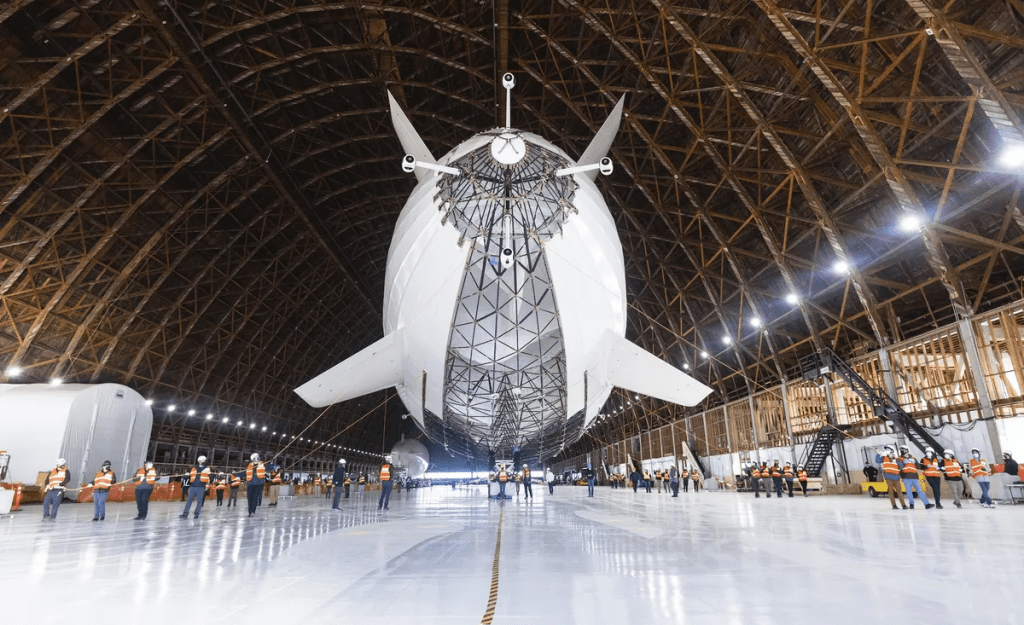
Pathfinder 1 in its hanger
The new airship being built at Moffet Field in the SF Bay Area, alongside UC Berkeley’s new Space Center, is another example of aerospace innovation occurring in the Golden State. At MOFFETT FIELD in Mountain View, Calif., Lighter Than Air (LTA) Research is floating a new approach to a technology that saw its rise and fall a century ago: lighter-than-air (LTA) airships. Although LTA airships have long since been supplanted by planes, LTA Research, which was founded in 2015 by CEO Dr. Alan Weston, Ph.D., believes that through a combination of new materials, better construction techniques, and other technological advancements, airships are poised to play an important role in society.
Unlike Goodyear blimps, LTA’s Pathfinder 1 floats bigger dreams than hovering over a sports stadium. The company sees a natural fit for airships in humanitarian and relief missions. Airships can stay aloft for long periods of time, in case ground conditions prevent cargo from arriving using conventional aircraft or land transportation, have a long range, and carry significant payloads, according to Dr. Carl Taussig, Ph.D., LTA’s chief technical officer.
Pathfinder’s cigar-shaped body is just over 120 meters in length and 20 meters in diameter. While that dwarfs Goodyear’s current, 75-meter Wingfoot One, it’s still only half the length of the Hindenburg. LTA expects Pathfinder 1 to carry approximately 4 tonnes (tonne equals 1000 kg) of cargo, in addition to its crew, water ballast, and fuel. The airship will have a top speed of 65 knots, or about 120 kilometers per hour—on par with the Hindenburg—with a sustained cruise speed of 35 to 40 knots (65 to 75 km/h). LTA has been building the massive aircraft, the largest since the Hindenburg, since 2015. A second larger airship, which is almost 600 feet long, is also under construction.
The new certificate permits LTA to fly Pathfinder 1 within the boundaries of Moffett Field and neighboring Palo Alto airport’s airspaces, at a height of up to 460 meters (1,500 feet). That will let it venture out over the southern part of San Francisco Bay, without interfering with planes flying into or out of San Jose and San Francisco International commercial airports.
In a letter supporting its application for the certificate, LTA wrote: “Pathfinder 1’s experimental flight test program is to demonstrate and establish the flight envelope for the airship…. LTA’s test plan is tailored to include substantial indoor and outdoor ground testing, using a build-up approach to gradually increase the flight envelope.”

The frame of Pathfinder 1
Expect traffic on the 101 highway in Mountain View, Calif., to be even worse in the days or weeks ahead, as motorists slow down to watch Google cofounder Sergey Brin’s 124-meter-long airship, Pathfinder 1, launch into the air for the first time.
IEEE Spectrum has learned that LTA Research, the company that Brin founded in 2015 to develop airships for humanitarian and cargo transport, received a special airworthiness certificate for the helium-filled airship in early September.
That piece of paper allows the largest aircraft since the ill-fated Hindenburg to begin flight tests at Moffett Field, a joint civil-military airport in Silicon Valley, with immediate effect.
The certificate permits LTA to fly Pathfinder 1 within the boundaries of Moffett Field and neighboring Palo Alto airport’s airspaces, at a height of up to 460 meters (1,500 feet). That will let it venture out over the southern part of San Francisco Bay, without interfering with planes flying into or out of San Jose and San Francisco International commercial airports.
In a letter supporting its application for the certificate, LTA wrote: “Pathfinder 1’s experimental flight test program is to demonstrate and establish the flight envelope for the airship…. LTA’s test plan is tailored to include substantial indoor and outdoor ground testing, using a build-up approach to gradually increase the flight envelope.”
The huge airship will initially be attached to a mobile mast for outdoor ground testing, before conducting about 25 low-level flights, for a total of 50 hours’ flight time.
Although its rigid design hearkens back to the gargantuan airships of the early 20th century, Pathfinder 1 is almost completely different from any large airship that has flown before. Crucially, its reported 3,000 welded titanium hubs and 10,000 carbon-fiber-reinforced polymer tubes are light enough that it can use nonflammable helium instead of explosive hydrogen as a lifting gas.
Twelve electric motors distributed on the sides and tail of the airship, and four fin rudders, allow for vertical takeoff and landing (VTOL) and speeds of up to about 120 kilometers per hour. A tough layer of laminated Tedlar material contains 13 helium bags of ripstop nylon, which contain lidar systems to track the gas levels within.
Pathfinder 1 has a hybrid propulsion system, with two 150-kilowatt diesel generators working alongside 24 batteries to provide power for the electric motors, according to a recent presentation by LTA’s CEO, Alan Weston. He said that LTA has plans to use hydrogen in later versions of the airship, perhaps as fuel for future fuel cells or turbogenerators, and possibly even as a lifting gas. Pathfinder 1’s airworthiness certificate is valid for a full year, although LTA told the FAA in its application letter that it expects the test program to be complete within 180 days.
 Stem Cells, Health, Technology