California by far is the leading state for venture funding and for innovation, and San Francisco leads the way. The state’s beauty and diversity (people and habitat), and being the most fun state in the US, are only a part of the attraction.
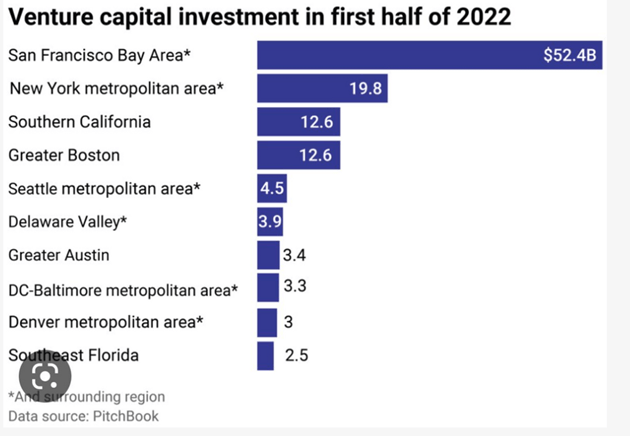
In the first half of 2022, California received $65 billion in VC funding. The much talked about Austin area, just $3.4 billion and SE Florida, $2.5 billion. Tax giveaways to corporations don’t work to develop a tech hub. They do lead to tattered public institutions, including public universities. Even the beautiful Denver Area, with the Rocky Mountains in view, has more innovation than does FL and is on par with Texas. Talk is cheap.
Missing from these data are those for San Diego, CA. Startups based in San Diego closed more than $9.6 Billion in VC capital in 2021. That’s more than in Austin, TX (4.9B) or in Miami, FL (4.6B), and more than those two cities combined. From solar EVs to fusion reactors, to AI, to microchips, to autonomous robots made for factories, to the world’s most sophisticated drones, to communications technology, to imaging systems in space, to lab grown fish, to genetically modified crops without introducing foreign DNA, to wind turbines (and here), to the design of Mercedes latest EVs, to the design of new stem cell-based skin care technologies based on a completely different means of therapeutic development, to new lithium extraction technologies, to new therapeutics, to DNA genomics and RNA genomics, to drug manufacturing, to EV battery R&D, to autonomous driving, to green recycling, to commercial and military satellites, to hardware and software solutions for the Artificial Intelligence of Things (AIoT) at Kneron, high resolution radar systems for autos, drones, and robotics, to autonomous mobile robots, to companies (MemComputing, a spinout of UCSD)) building a new computing paradigm – self-organizing logic gates, it all happens in San Diego.
Even the inland area of Livermore, CA has more innovation than does Austin TX or Miami FL. Or, over in Berkeley, a haven for startups (2nd only to nearby Stanford), near the Pixar studies, you’ll find energy companies such as Voltaiq and robotics companies started by Berkeley professors, such as Ambi Robotics, Squishy Robotics, and Emancro Robotics. Databricks, valued at $31 billion, started their too, as did the biotech industry back in 1971 with the founding of Cetus by Berkeley professors. Talk of Austin and Miami as the next big tech hubs is just right-wing BS trying to push the idea that conservative states are successful.
NY and Boston are 2nd and 3rd, and Seattle is 4th for the 2022 first half data that fail to categorize San Diego, which is likely ranked just after Boston. Yes, liberal states with great universities and public policies that drive the greater good, dominate. Forget the mumbo jumbo libertarian nonsense that low taxes and deregulation, and a lack of government engagement lead to innovation and great economies. They don’t. Government money spent on the greater good and directed at innovation and education are big drivers. Consider the latest ranking by U.S. News and World Report. Three of the world’s top 10 universities are Berkeley, Caltech, and Stanford, and three more — UCLA, UC San Francisco and UC San Diego — round out the top 20. And USC in Los Angeles is #25, UC Santa Barbara is #32, UC Irvine is #34, UC Davis is #38, UC Riverside #89, and even the brand new UC Merced is ranked above anything in Florida at #97. Of the Best National Liberal Arts Colleges, Pomona College near Los Angeles is #3. By contrast, Texas’ top school, the University of Texas Austin, ranks 43rd and Florida’s best school, the University of Florida, is 98th (and that’s before regressive Gov. Ron DeSantis’ education reforms targeting “liberal elites” begin to downgrade the state’s mediocre schools). This is a big reason why California is booming, the innovation hub of the planet, and why San Francisco’s “Cerebral Valley” is rapidly developing in 2023 in an Artificial Intelligence (AI) boom, especially in generative AI. AI is hot, and so are the microelectronic chips that power them – all of which is centered in the SF Bay Area. For example, a new era of machine learning electronic microchips for embedded edge computation is unfurling in the SF Bay Area. This means AI chips placed where they are used, such as in an EV, drone, or eVTOL. Companies such as SiMa.ai in San Jose are leading the way. Some of these companies may become the next Databricks, a startup that grew out of a project at UC Berkeley, to become a data storage and analytics giant worth $31 billion in 2022. The 5,500 employees at the company handle data for massive companies like AT&T, Shell and Walgreens. Another AI company has been developed at UC Berkeley. Whereas Databricks focuses on data science, Anyscale focuses on a different problem companies encounter when building AI models: computing power. Anyscale’s technology uses Ray to create what cofounder Dr. Ion Stoica, Ph.D., professor at Berkeley, calls an “infinite laptop” in which the computing strain is distributed from one computer to many through the cloud. Anyscale raised at a $1 billion valuation in December 2021, largely on the promise of its open-source technology, is being used widely, including by other AI companies, such as Open AI. Berkeley Ph.D. recipient John Schulman, was a co-founder of OpenAI and the primary architect of ChatGPT. Powering these AI platforms is a new chip technology developed by Cerebras, co-founded by Michael James, a UC Berkeley alum. Other companies, such as Rivian, building intelligent EVs that are reliant on AI, move to California because of the massive, highly educated talent in the state. Looking at AI alone, you begin to see the importance of California supporting the world’s best university system, The University of California. Other companies, such as Rivian, building intelligent EVs that are reliant on AI, move to California because of the massive, highly educated talent in the state.
Texas is the land of oil, where you don’t need a brain to dig a hole in the ground. VCs don’t fund ditch diggers. And Florida is the #1 state for fraud, drugs, and money laundering, with Miami and the Bahamas a center for crypto fraud. In Florida, their idea of a tech tycoon is someone illegally buying cheap electronics from China and labeling the devices as Cisco (a SF Bay Area company), selling garbage at premium prices. In 2010, prescription drug manufacturers shipped more than 650 million oxycodone pills to the state, which equates to over 34 pills for every single Floridian. They’re dazed and confused in Florida, poorly educated, and/or old, and that’s not what VC funds. The jacket of Florida’s first-something-or-other, Casey DeSantis, summed it up, Florida is where innovation dies and the Reptilian brain lives.
If we look at the emerging AI boom, where is it happening?

The answer, of course, is California. And San Francisco is the epicenter. Florida is nowhere to be found, and Texas is barely represented.
Crypto fraud abounds in Florida, from Stuart to Miami, and 50 miles away in the Bahamas. Also boosting the Florida economy besides fraud and money-laundering is the massive amount of repair work from floods and hurricances. The billions of dollars in federal disaster relief and insurance money that flow into Florida for repairs and rebuilding in the quarters following a disaster will register as more production of goods and services, boosting GDP.
Tech companies, such as Krea, started in the land of fraud, Miami, Florida, just keep coming to California to build their success. While most are started in California, the few started elsewhere, such as Single Sprout, often move here to be in the center of action and to leverage the intellectual talent pool in CA. Even Tesla, given gobs of money by Texas to move there, after a short stent in Texas, Musk has moved Tesla’s HQ back to California so that the company can stay in the forefront of innovation. To sum up, the state of California had more than 222,000 business startups from January 2020 through March 2021 – more than Texas and Florida combined. During this period, California accounted for nearly 16% of the country’s new business starts. And it has not slowed down, it’s booming. One example, Joby Aviation in Santa Cruz, a pioneer of eVTOL aircraft, another industry started in CA, that is flourishing in California with other pioneers such as Archer Aviation in Santa Clara, Overair in Santa Ana, Wisk Aero in Mountain View (has flown the first autonomous eVTOL), Opener Aero in Palo Alto (customers are already flying their eVTOL), Jump Aero in Petaluma, Aska in Mountain View, Pyka in Oakland, and Elroy Air in San Francisco are building various forms of electric, eVTOL, and autonomous eVTOL aircraft for cargo transport.


Leave a comment