Semiconductor Factory in Arizona Can’t Find Qualified Workers

Really, building a high-tech plant in the middle of a desert where it’s been over 110 deg F for at least 21 days straight, and where fewer than half of Arizona high school graduates went on to college?

The hottest day of the year in Phoenix, AZ happened Wednesday when the temperature reached 119 degrees at 2:42 p.m., according to the National Weather Service. Who the heck would want to live in this inferno of a place – certainly not highly educated people. And educated people are needed to make a successful chip factory.

Chip makers build plants in the state because of few regulations and many tax breaks. But some of the tax breaks have rankled Arizona residents, who say the moves have hurt funding for public schools. The state ranks 47th in per-student spending. “Corporations are choosing not to settle in Arizona because of our devastated public education system.” It’s similar to states in the South, who have the country’s worst schools.

And AZ is in a perpetual drought and lacks water. Construction has halted on projects because of the water shortage. A factory or “fab” for making semiconductors needs a lot of water to operate. It’ll guzzle between 2 to 4 million gallons of water a day by some estimates, using the water to cool down equipment and clean silicon wafers.  Republican Governor Doug Ducey helped make this mess. Deregulation and tax breaks are great for the wealthy and corporations, not for the people.

Don’t you just love how the wealthy and the rich corporations play one state off of another? Plutocrats, such as Musk and Bezos, find the states that will give them money and tax breaks, no regulations so that they can pollute the area, pay workers substandard wages, treat their workers in harmful ways in their factories, and abuse the infrastructure that’s present and not create new, needed infrastructure. And even worse, the US government supports these regressive states by giving them tax dollars to build these substandard, polluting factories, using the money mostly derived through tax dollars from the extremely wealthy states of California and New York. In the fiscal year of 2022, the state of California collected a total of 280.83 billion U.S. dollars in tax revenue, the highest of any state. New York collected the second highest amount of taxes in that year, coming in at 117.98 billion U.S. dollars. And the money we paid-in is being used to abuse the people and the environment in red states. The states that protect their environment, build infrastructure such as the world’s greatest public university system, and protect their workers, and give the most money to the system, receive little in return from the US. We do it on our own, and California is booming despite having to support the rest of the US.

Chemically Induced Reprogramming to Reverse Cellular Aging – Why This Headline is Phony

David Sinclair is a popular media darling for a reason, and it’s not because of great science. Rather, the reason is what philosopher, Dr. Harry G. Frankfurt, Ph.D., called bullshit.

David Sinclair at Harvard has claimed to have used a cocktail of chemicals to reverse aging. He hasn’t. Let’s see why he hasn’t. In his study, he isolated human fibroblasts, a type of mesenchymal progenitor cell that occurs throughout much of the human body, including the skin where they can easily be obtained as biopsied donor tissue. The cells were then either fed a cocktail in one group versus another group that didn’t receive the cocktail. So the comparator group was essentially given nothing – it’s a so-called placebo control. In the so-called placebo group you basically do nothing other than the standard procedure to help out the cells. It’s similar to a placebo controlled clinical trial where you compare a “heart medication” to a group where individuals who are obese and eat a horrible diet do nothing to correct their ill health. Imagine comparing the drug to obese, poor-eating individuals who start eating a great diet and lose weight during the trial. Which group, the drugged group or the healthy lifestyle group, would have the better improved outcomes? Answer: those eating better and losing weight. So Sinclair in his study doesn’t do anything in the comparator group to make the cells healthy. Many nutrients can make cells in culture have better longevity, including the commercial supplement PowerFeed A from Lonza. Shall we start an infomercial campaign for drinking PowerFeed A from Lonza to induce longevity? I think not. That would be as absurd as what Sinclair is feeding the hysterical mass media.

But what was Sinclair measuring, longevity? No. He wasn’t. He was measuring transcripts from the fibroblasts, i.e. RNA. Disease and longevity are a function of proteins, not RNA. Environmental insults are the cause of about 90% of diseases, and these environmental insults act predominantly on proteins, including brain diseases. And just because your RNA profile demonstrates a “better longevity profile” after the cocktail doesn’t mean your proteins will demonstrate a better longevity profile. They won’t, or at least, many won’t. Many proteins in the body are long-lived, including in our mitochondria, meaning once the protein is made you’re stuck with it for years, or decades, or even throughout most of your life. Transcripts don’t mean diddly for long lived proteins because your not replacing those proteins. Even when the protein is made through transcription-translation, the protein will be further modified through post-translational modifications. And post-translational modifications are a big factor in aging. Environmental factors can destroy the function of proteins, doing so through post-translational modifications. One simple example is the glycation of collagen fibrils in the human body, increasing the odds of cancer, diabetes, dementia, and old looking, poorly functioning skin. It’s complex, but basically proteins become glycated through interactions with too much sugar, including though dietary sugars. Glycated proteins in the extracellular matrix of the skin and blood vessels, for example, become less sensitive to proteolysis. Thus glycated collagen fibers within the arterial wall become resistant to remodeling enzymes. As a result, these proteins accumulate, irreversibly thickening the vessel wall. Again, transcripts don’t mean diddly for glycated proteins because you’re not replacing those proteins. If you want to learn some of the things you can do to reduce glycation to improve healthspan and possibly lifespan, read here.

Another big problem with Sinclair’s work is the total absence of considering intrinsically disordered proteins (IDPs). These are proteins that lack 3-dimensional structure, are easily modifiable, whose function depends on the protein’s surroundings, and that account for about a third of all proteins in the body. These proteins are characterized by their low content of bulky hydrophobic amino acids. They are smaller and more pliable than their globular 3-dimensional counterparts, and therefore much more free to operate as a function of their environment. Thus, our exposome likely affects the IDPs, and mRNA transcript characterization would mean little to how the IDP is functioning.

Others have written about David Sinclair’s propensity for bullshit, money, and bad science, and it’s sad this guy gives science and scientists a bad name through the echo chambers of a poorly engaged mass media peddling his phony science. When talking about Sinclair’s work, fellow molecular biologist at Harvard, Dr. Gary Ruvkun, Ph.D,, has said, “Don’t believe anything you’ve heard.” Basically, we’re talking about more BS from US medical schools, funded by the National Institutes of Health, which is run by physicians, such as Francis Collins, with a propensity for bullshit (the genome will predict all diseases) and fraud. The field is besieged by “medical fakery” as exemplified by phony clinical trials. And then this fakery is sold by practicing physicians who act as technical sales reps for the drug companies. Making this fakery even is worse, is that drug companies pay physicians to sell their drugs using physicians who don’t what they’re doing and/or commit malpractice. The medical industry is often perverse and driven by a desire for power, fame, and money (Sacklers are an example of such physicians), and many people are suffering as a result. This is a world-wide phenomenon, from the halls of Harvard, to medical practices in Texas, to academic physicians in Italy, it’s pervasive. Over half of FDA approved drugs don’t work, industry knows it and in a major conflict of interest, funds 3/4 of the FDA budget of the division that regulates drugs, and David Sinclair’s work is not helping to bring forth therapeutics that work.

Texas’ Abbott Worried About the Border, But the Big Problem is Within the Texas Border – Another Mass Shooting, And Another, And Another…

What’s Bigger in Texas? Answer: Mass Shootings.

Border agents encountered 70 percent fewer crossings in the three weeks following the end of Trump’s Title 42, compared to the week before the policy expired, according to the Department of Homeland Security. So border crossings are way down under Biden compared to Trump’s mess. But the mean-spirited Greg Abbott will never tell that story. Nor will Abbott tell the story of chemical plants exploding daily, ranches exploding, polluting the state and leading to the illness and slow death of Texas residents, and Texas as the worst place to live in the US. Some things are bigger in Texas – pollution is one. Daily shootings, leading to the instantaneous death of many, and a life of sadness and anger for the families of the victims. This too is bigger in Texas. Texas is a red-state hell led by a misanthrope named Abbott. Here’s a report on today’s Texas massacre. Yes, another mass shooting in El Paso. Texas leads the nation in mass shootings, where it’s easier for a teenager to buy and open carry an AR-15 style assault rifle than it is to buy a beer. And here’s the mass shooting the following day in Ft. Worth, TX. Three dead, eight others injured. And the next one within weeks in Houston.

Texas is home to slightly more than 6,000 gun sellers, according to May 2022 licensing data from the Bureau of Alcohol, Tobacco, Firearms and Explosives. That’s more than twice as many as any other state. Texas also led the U.S. in estimated minimum gun sales from 2017 to 2020, according to a new ATF report, and was first in most major categories of licensed gun sales. Texas also has had more people killed in mass shootings than any other state, according to data compiled by Everytown for Gun Safety stretching back to 2009, and the second-highest number of people killed in a single mass shooting, behind Nevada.

This is a state with the most permissive gun laws, and people are dying because of it. Nationwide, Texas and Florida (a state that’s gone deep red of late and led by a man who delights in torture) were responsible for about 20% of all reported multiple gun sales, the ATF report said. Texas Republicans pushed through the new permitless gun carry law, which allows residents to openly carry guns without a permit. Abbott devised, approved and signed the law against the advice of law enforcement officials. Abbott is an asshole.

Covid-19 Vaccine-Induced Autoimmune Disease: Case Study with Therapeutic and Dietary Regimen

Reports continue to use terms, such as “Rare link” and “Rare cases,” and “COVID-19 vaccines have saved millions of lives” to obfuscate the impact of widespread Covid-19 vaccine injuries. I’ve previously suggested in two peer-reviewed, PubMed listed papers (Maguire, 2021; Maguire, 2022) means to develop vaccines for respiratory diseases that better prevent the spread of virions and also reduce the probability of vaccine injury.

As I’ve described in a preprint about Covid-19 vaccine injury, Covid-19 mRNA vaccines use technologies that have never previously been implemented in vaccines. For example, PEG , part of the lipid nano-particle (LNP) containing the mRNA, has never been used before in an approved vaccine. Over 70% of people tested develop antibodies against PEG, and 7% can develop anaphylactic shock. The long term consequences are not understood. Concerning too is that mRNA vaccines may introduce DNA into the host genome, thus potentially introducing viral proteins to the host immune system for extended periods. Unlike what physicians in the media have said (Offit, 2021), humans possess robust reverse transcriptase enzymes that can write RNA sequences into DNA (Chandramouly et al, 2021), and the possibility exists that mRNA vaccines may introduce a DNA message into human genomes (Zhang et al, 2021; Alden et al, 2022). Indeed, free spike antigen was detected in the blood of adolescents and young adults who developed post-mRNA vaccine myocarditis. Individuals who developed postvaccine myocarditis uniquely exhibit elevated levels of free spike protein in circulation, unbound by anti-spike antibodies, which appear to correlate with cardiac troponin T levels and innate immune activation with cytokine release. One study has found the spike protein in circulation of the mRNA vaccinated for 6 months following injection. Circulating spike protein following vaccination originates from endogenous production, and its concentration is therefore likely higher in tissues where production occurs compared to what is observed in the blood. For example, levels of the neurotransmitter dopamine are up to 100 million times higher in brain areas where it is produced, in comparison to plasma where it occurs as a result of tissue spillover. Thus, if spike protein is being made because the mRNA vaccination became incorporated into our DNA, then measuring spike protein in our blood may not be the best indicator. More work is required to provide good evidence whether this is happening long term in vaccinated humans through incorporation into the DNA (Doerfler, 2021). Understand, that if your body is continuously making Covid-19 spike proteins, chronic activation of your innate and adaptive immune systems and related inflammation may be occurring. Also understand that these vaccines don’t stop or reduce transmission of the disease, but masks do. If you want to avoid Covid-19 infection, wear an effective mask, such as N95 or KN95, socially distance, and avoid places with poor ventilation.

Also, although chemical modifications in the RNA molecules used in vaccines are intended to decrease TLR (toll-like receptor) sensing of external single-stranded RNAs, and thus triggering proinflammatory signals, there is some evidence that modified uracil residues do not completely abrogate TLR detection of the mRNA. Also, while efforts are made to reduce proinflammatory double-stranded (ds) RNA production, there may be small amounts of dsRNA that can occasionally be packaged within mRNA vaccines. Further, inflammatory responses can be exacerbated on a background of pre-existing inflammatory conditions, as was recently shown in a mouse model after administration of mRNA–LNPs. This effect was found to be specific to the LNP, acting independently of the mRNA cargo. Given compounding inflammation with each dose, frequent booster immunizations may increase the frequency and/or the severity of the reported AEs. An informative review of this is available.

As Danice Hertz, MD has written in a response to an article about Long Covid, “There
are many thousands of people who have suffered a similar neurological syndrome as a
result of receiving a Covid vaccine. I am one of those people and have severe
neuropathic pain from head to toe as well as tinnitus, dizziness, imbalance, blurred
vision, fatigue, headaches for 14 months now. Many of us have been diagnosed with
small fiber neuropathy, dysautonomia and mast cell activation syndrome. It is time that
these vaccine reactions be acknowledged, and that research be conducted to help
understand the mechanism of injury so better treatments can be available to help those
like me who have suffered terrible injury from the vaccines” (George, 2022). Recently,
Gregory Poland, MD, director of the Mayo Clinic’s Vaccine Research Group in
Rochester, Minnesota, reported his severe tinnitus after receiving the second dose of a
mRNA covid-19 vaccine. “It was like someone suddenly blew a dog whistle in my ear,”
Poland told MedPage Today. “It has been pretty much unrelenting.” Since then, Poland
said he has been experiencing what he describes as life-altering tinnitus. Commenting
on his symptoms, he “can only begin to estimate the number of times I just want to
scream because I can’t get rid of the noise or how many hours of sleep I’ve lost,”
(Henderson, 2022). Dr. Hertz has also made comments at FDA meetings about these vaccines.

Quoting from Scorza and Finisterer (2021), “Real world data rather indicate that the
spectrum of side effects to any of the commercially available SARS-CoV-2 vaccinations
is broader than anticipated, underreported, and played down. Side effects need to be
thoroughly elaborated to draw more real pictures than those frequently sold. Real world
is more unsafe than its propagated image.” The role of vaccines in inducing
autoimmune disease needs to be studied (Chen et al, 2001; Toussirot and Bereau,
2015
; Principi and Esposito, 2020; Chen et al, 2022).

Autoimmune encephalitidies ((Zlotnik et al, 2021), venous sinus thrombosis (Finisterer
and Nics, 2021
; Sharifian-Dorche et al, 2021), intracranial hemorrhage with venous
sinus thrombosis occurring in the same patient (Purkayastha et al, 2021), and glial
fibrillary acidic protein astrocytopathy (GFAP-A) can result following the second dose of
an mRNA vaccine (Koh et al, 2022). Autoimmune encephalitis is difficult to diagnose
with current clinical diagnostics and therefore often goes untreated (Graus et al, 2016).
Autoantibodies can persist for at least 6 months following even mild Covid-19 disease
(Liu et al, 2021; Su et al, 2022). Neurological symptoms will result (Patone et al, 2021;
Finisterer, 2022), including memory and attention deficits for up to 9 months (Zhao et al,
2022), and brain autoimmunity with attack of myelin in neurons may result (Gupta and
Weaver, 2021
; Shabani, 2021). Autoantibodies acting on vascular endothelial cells
(Bouillet et al, 2013) in the part of the blood supply that feeds the brain, can cause
thrombotic thrombocytopenia (Zuo et al, 2020; Gunther et al, 2021), and cerebral
venous sinus thrombosis (Finsterer, 2021), and may also underlie the generalized
report of “brain fog” in such patients and other forms of encephalopathy (Huang and
Huang, 2022). Recent studies have found that spike proteins in SARS-CoV-2 attach to
vimentin (Amraei et al, 2022), which is present at the extracellular surface of endothelial
cells. This is a possible mechanism underlying the vaccine induced vascular
abnormalities. Autoantibodies are also known to attack neutrophils, a key component of
the innate immune response, and therefore could be an important reason for severe
Covid-19 in those with autoimmune disease, potentially even that induced from
vaccination (Weiner and Segelmark, 2016). Douaud et al (2022) found that Covid-19
whether severe or non-severe (not hospitalized), have significant brain damage.

As I discovered, a diet that limits autoimmunity can help to reduce the vaccine-induced autoimmune disease. Read what I found out and strictly follow my advice. You can greatly reduced your symptoms. My article is free here.

“Prescription drugs are the third leading cause of death” Dr Peter C. Gøtzsche, M.D.

“Most patients will derive no health improvement from medication. We should tackle the root causes of disease instead.” Dr. Aseem Malhotra, M.D.

Prescription drugs are the third leading cause of death, and most patients derive no health benefit from these killer drugs. And many people will be misdiagnosed by physicians, then given a drug that they don’t need. An estimated 371,000 people die every year following a misdiagnosis, and 424,000 are permanently disabled. Therefore, a total of 800,000 people suffer serious harm from misdiagnosis. According to the study’s lead author, Dr. David Newman-Toker, MD, PhD, “We focused here on the serious harms, but the number of diagnostic errors that happen out there in the U.S. each year is probably somewhere on the order of magnitude of 50 to 100 million. That’s potentially 100 million people a year being misdiagnosed and then given inappropriate, harmful drugs. All drugs have side effects, and if the drug your given is unnecessary with no benefit, all you receive are the side effects. SSRI drugs are a case in point. Quoting from Danborg et al (2019), “Millions of people are treated with antidepressants like selective serotonin reuptake inhibitors (SSRIs) or serotonin-norepinephrine reuptake inhibitors (SNRIs). This clinical practice is based on short-term trials that have exaggerated the benefits and underestimated the harms. We also know too little about long-term harms.”

Further, “There are many problems with placebo controlled trials of antidepressants. The trials are of short duration, a median of only 9 weeks; withdrawal effects are almost always introduced in the placebo group because the patients were already in treatment before they were randomised; lack of effective blinding; attrition; and selective reporting of major harms. Published papers have therefore exaggerated the benefits and underestimated the harms. Despite these difficulties, we do know that short term use of antidepressants can cause irritability, anxiety and panic, emotional flattening, dyskinesias, sexual impairment and also suicidality and aggression, even in healthy adult volunteers. In observational studies, antidepressants have been linked to increased risk of dementia; they may induce depressogenic effects; and the prevalence of treatment-resistant depression appears to be increasing. Antidepressants have stimulant effects and rather than acknowledging this drug harm, it has led to a diagnosis of bipolar disorder in about 10% of children aged 10–14 years under the care of mental health services, which is a far worse disease than depression and is often treated with antipsychotics. Similar results have been reported for adults. Despite the fact that we base our clinical practice on short-term trials, many patients continue on the drugs for years. A major reason for this is that they have difficulty coming off the drugs again because of withdrawal effects, which for SSRIs are very similar to those the patients experience when they try to stop benzodiazepines.” Many physicians, in a conflict of interest, foisted these nasty drugs on society.

When we look for root cause of disease, what do we find? Most diseases are caused by our exposome, including environmental factors. I was sickened to see a recent NY Times article entitled, “Suddenly, It Looks Like We’re in a Golden Age for Medicine.” Such an uninformed article results from “The Medicalization of America.” While most diseases are not because of hereditary genetics, the Times article starts with lauding a methodology called CRISPR for gene editing, stating that CRISPR is “opening up what seemed like an almost limitless horizon for Crispr-powered therapies and cures.” This is looking for diseases in all the wrong places – namely the genome.

In reading Dr. Rapapport’s (professor at Berkeley) work, we learn that most genome-wide-association studies (GWAS) have not detected large effects of common genetic variants on disease incidence. The small effect sizes identified from single nucleotide polymorphisms detected by GWAS are consistent with studies of monozygotic twins that point to contributions of entire genotypes toward cancer and cardiovascular disease of 8% and 22%, respectively. Thus, in weighing the relative influences of heritable genetics and environmental exposures on chronic diseases, the modest effects of heritable genetics suggest that exposures and/or gene–environment interactions (G × E) are major causal factors. Indeed, about half of the 50 million global deaths in 2010 were attributed to 18 environmental exposures, led by tobacco smoking, particulate air pollution and indoor smoke, high plasma sodium, and alcohol use. The clear implication is that epidemiologists seeking unknown causes of chronic diseases should employ a balanced strategy that characterizes both heritable genetics and exposures at high resolution. However, because the human genome project mistakenly focused exclusively on the genome, it did not motivate the discovery of causal exposures. Indeed, etiological research still focuses on only a few hundred chemicals or mixtures that are quantified by combinations of questionnaires, deterministic models and some measurements. By continuing to explore such a small universe of exposures, we limit our chances to discover unknown causes of disease.

What does this mean? Most diseases are from exposures to chemicals and are therefore preventable. A big component of your exposome is your diet, including what you eat and drink. What you breathe is another huge factor. And because most diseases are not genetic, gene therapy is not the solution. If you want to be healthy, pharma’s drugs and physician’s procedures won’t do it for you. Lifestyle changes will. Remember, most people don’t receive benefit from drugs. They do receive benefit from what they eat and drink.

Does Atrazine Induce Complete Feminization and Chemical Castration in Male Frogs? Yes, 10% of Those Exposed to 2.5ppb.

Commonly used herbicide, Atrazine, was found to transform 10% of genetically male frogs into females and hermaphrodites 

In the 2010 study from UC Berkeley, 100% of the animals tested were genetic males. As a result, all hermaphrodites and females observed to transform were ensured to be genetic males that were altered by endocrine disruption. Examination was of sex ratios, testosterone levels, sexual dimorphism, reproductive behaviors, and fertility in males exposed to 2.5 ppb atrazine throughout the larval period and for up to 3 years after metamorphosis.

From the study: “All of the control animals reared to sexual maturity (n = 40) were males, on the basis of external morphology, whereas only 90% of the atrazine-treated animals (36 of 40) appeared male at sexual maturity (on the basis of the presence of keratinized nuptial pads on the forearms and the absence of cloacal labia). The other 10% of atrazine-exposed animals (n = 4) lacked visible nuptial pads on the forearms and had protruding cloacal labia, typical of females (Fig. 1). Upon dissection of two of the apparent females and laparotomy in another two, we confirmed that animals with cloacal labia were indeed females from the present study, on the basis of the presence of ovaries (Fig. 1F). To date, two atrazine-induced females have been maintained, mated with control males (Fig. 1G), and produced viable eggs (Fig. 1H). The resulting larvae were all male when raised to metamorphosis and sampled (n = 100), confirming that atrazine-induced females were, in fact, chromosomal males.”

Similar results have been found in other studies. There are many other documented reproductive effects of atrazine in laboratory rodents: induced abortion, impaired mammary development, the induction of reproductive and hormone-dependent cancers as well as other non-reproductive effects including impaired immune function (also observed in multiple studies across vertebrate classes) and impaired neural development. Thus, with the additional the indirect effects of atrazine on habitats, atrazine can have dramatic effects on ecosystems, environmental health and public health.

Recent studies suggest that atrazine has negative developmental effects in humans too. I remind you that most diseases are environmentally triggered, not heritable genetics. This includes, for example, ALS. We live in a chemical stew. Among the chemicals wreaking havoc on our bodies are endocrine disruptors such as prescription drugs, plastics, phthlates, ‘forever’ chemicals that we’ve been manufacturing and circulating into our environment and bodies since especially World War II. 

More than a half million pounds of atrazine are precipitated in rainfall each year in the United States. It’s a problem, people. And, just because RFK, Jr. repeated the info from these studies, doesn’t mean it isn’t true. Stop your emotional, political bullshitting, and read the actual studies.

Private, For-Profit Company Loses People on the Ocean Floor – Public Institutions Are Sent in to Save Them

  1. Who Makes Money? and, 2. Who Pays for Those Who Make the Money?

Answer- 1. Private Corporations, 2. Taxpayer Supported Public Institutions.

The missing submersible is operated by OceanGate Expeditions, a company that offers tours of shipwrecks and underwater canyons.  Rich people pay $250,000 to travel to the Titanic’s wreckage on the seabed on the submersible. These are some of the same people who pay millions for joy rides into space. Aircraft from the United States and Canada were searching for the submersible, and sonar buoys had been deployed to help search under the surface. The Coast Guard was also coordinating with commercial vessels in the area to aid the search operation. Millions of dollars of the people’s tax dollars are being used to find these plutocrats. When interviewed, a local taxpayer who works two jobs for $7.25/hour cleaning the toilets for plutocrats, said; “I hope they find those guys because the 32% in taxes I pay to support plutocrats who pay 3% in taxes, is really fair. My local Republican congressman told me I need to work harder, and someday I can ride in a free enterprise submersible.”

At a news conference in Boston on Monday afternoon, Rear Adm. John Mauger of the U.S. Coast Guard said that rescue crews were searching in a “remote area” in water roughly 13,000 feet deep, and that they were up against the clock to find those on board the vessel.

In a world run by plutocrats alive with algorithms and intelligences actively rewarding our most selfish tendencies, let’s not rediscover community, mutual aid, and human interdependency. Instead, let’s hope we can find these plutocrats so that the millions of dollars they’ve squandered from the people of the US can be used for future squandering.

Venture Capital 2022 – California is the land of Innovation

California by far is the leading state for venture funding and for innovation, and San Francisco leads the way. The state’s beauty and diversity (people and habitat), and being the most fun state in the US, are only a part of the attraction.

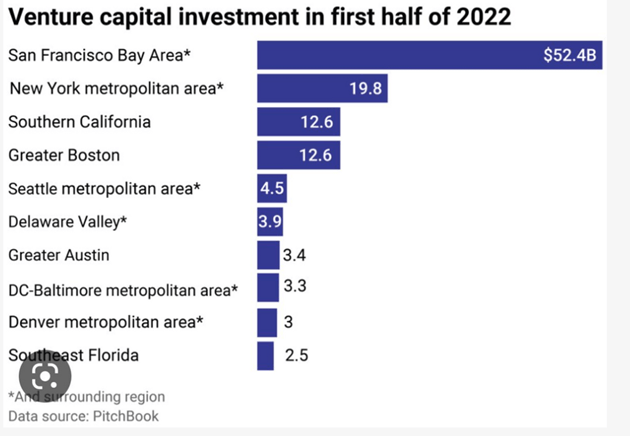
In the first half of 2022, California received $65 billion in VC funding. The much talked about Austin area, just $3.4 billion and SE Florida, $2.5 billion. Tax giveaways to corporations don’t work to develop a tech hub. They do lead to tattered public institutions, including public universities. Even the beautiful Denver Area, with the Rocky Mountains in view, has more innovation than does FL and is on par with Texas. Talk is cheap.

Missing from these data are those for San Diego, CA. Startups based in San Diego closed more than $9.6 Billion in VC capital in 2021. That’s more than in Austin, TX (4.9B) or in Miami, FL (4.6B), and more than those two cities combined. From solar EVs to fusion reactors, to AI, to microchips, to autonomous robots made for factories, to the world’s most sophisticated drones, to communications technology, to imaging systems in space, to lab grown fish, to genetically modified crops without introducing foreign DNA, to wind turbines (and here), to the design of Mercedes latest EVs, to the design of new stem cell-based skin care technologies based on a completely different means of therapeutic development, to new lithium extraction technologies, to new therapeutics, to DNA genomics and RNA genomics, to drug manufacturing, to EV battery R&D, to autonomous driving, to green recycling, to commercial and military satellites, to hardware and software solutions for the Artificial Intelligence of Things (AIoT) at Kneron, high resolution radar systems for autos, drones, and robotics, to autonomous mobile robots, to companies (MemComputing, a spinout of UCSD)) building a new computing paradigm – self-organizing logic gates, it all happens in San Diego.

Even the inland area of Livermore, CA has more innovation than does Austin TX or Miami FL. Or, over in Berkeley, a haven for startups (2nd only to nearby Stanford), near the Pixar studies, you’ll find energy companies such as Voltaiq and robotics companies started by Berkeley professors, such as Ambi Robotics, Squishy Robotics, and Emancro Robotics. Databricks, valued at $31 billion, started their too, as did the biotech industry back in 1971 with the founding of Cetus by Berkeley professors. Talk of Austin and Miami as the next big tech hubs is just right-wing BS trying to push the idea that conservative states are successful.

NY and Boston are 2nd and 3rd, and Seattle is 4th for the 2022 first half data that fail to categorize San Diego, which is likely ranked just after Boston. Yes, liberal states with great universities and public policies that drive the greater good, dominate. Forget the mumbo jumbo libertarian nonsense that low taxes and deregulation, and a lack of government engagement lead to innovation and great economies. They don’t. Government money spent on the greater good and directed at innovation and education are big drivers. Consider the latest ranking by U.S. News and World Report. Three of the world’s top 10 universities are Berkeley, Caltech, and Stanford, and three more — UCLA, UC San Francisco and UC San Diego — round out the top 20. And USC in Los Angeles is #25, UC Santa Barbara is #32, UC Irvine is #34, UC Davis is #38, UC Riverside #89, and even the brand new UC Merced is ranked above anything in Florida at #97. Of the Best National Liberal Arts Colleges, Pomona College near Los Angeles is #3. By contrast, Texas’ top school, the University of Texas Austin, ranks 43rd and Florida’s best school, the University of Florida, is 98th (and that’s before regressive Gov. Ron DeSantis’ education reforms targeting “liberal elites” begin to downgrade the state’s mediocre schools). This is a big reason why California is booming, the innovation hub of the planet, and why San Francisco’s “Cerebral Valley” is rapidly developing in 2023 in an Artificial Intelligence (AI) boom, especially in generative AI. AI is hot, and so are the microelectronic chips that power them – all of which is centered in the SF Bay Area. For example, a new era of machine learning electronic microchips for embedded edge computation is unfurling in the SF Bay Area. This means AI chips placed where they are used, such as in an EV, drone, or eVTOL. Companies such as SiMa.ai in San Jose are leading the way. Some of these companies may become the next Databricks, a startup that grew out of a project at UC Berkeley, to become a data storage and analytics giant worth $31 billion in 2022. The 5,500 employees at the company handle data for massive companies like AT&T, Shell and Walgreens. Another AI company has been developed at UC Berkeley. Whereas Databricks focuses on data science, Anyscale focuses on a different problem companies encounter when building AI models: computing power. Anyscale’s technology uses Ray to create what cofounder Dr. Ion Stoica, Ph.D., professor at Berkeley, calls an “infinite laptop” in which the computing strain is distributed from one computer to many through the cloud. Anyscale raised at a $1 billion valuation in December 2021, largely on the promise of its open-source technology, is being used widely, including by other AI companies, such as Open AI. Berkeley Ph.D. recipient John Schulman, was a co-founder of OpenAI and the primary architect of ChatGPT. Powering these AI platforms is a new chip technology developed by Cerebras, co-founded by Michael James, a UC Berkeley alum. Other companies, such as Rivian, building intelligent EVs that are reliant on AI, move to California because of the massive, highly educated talent in the state. Looking at AI alone, you begin to see the importance of California supporting the world’s best university system, The University of California. Other companies, such as Rivian, building intelligent EVs that are reliant on AI, move to California because of the massive, highly educated talent in the state.

Texas is the land of oil, where you don’t need a brain to dig a hole in the ground. VCs don’t fund ditch diggers. And Florida is the #1 state for fraud, drugs, and money laundering, with Miami and the Bahamas a center for crypto fraud. In Florida, their idea of a tech tycoon is someone illegally buying cheap electronics from China and labeling the devices as Cisco (a SF Bay Area company), selling garbage at premium prices.  In 2010, prescription drug manufacturers shipped more than 650 million oxycodone pills to the state, which equates to over 34 pills for every single Floridian. They’re dazed and confused in Florida, poorly educated, and/or old, and that’s not what VC funds. The jacket of Florida’s first-something-or-other, Casey DeSantis, summed it up, Florida is where innovation dies and the Reptilian brain lives.

If we look at the emerging AI boom, where is it happening?

The answer, of course, is California. And San Francisco is the epicenter. Florida is nowhere to be found, and Texas is barely represented.

Crypto fraud abounds in Florida, from Stuart to Miami, and 50 miles away in the Bahamas. Also boosting the Florida economy besides fraud and money-laundering is the massive amount of repair work from floods and hurricances. The billions of dollars in federal disaster relief and insurance money that flow into Florida for repairs and rebuilding in the quarters following a disaster will register as more production of goods and services, boosting GDP.

Tech companies, such as Krea, started in the land of fraud, Miami, Florida, just keep coming to California to build their success. While most are started in California, the few started elsewhere, such as Single Sprout, often move here to be in the center of action and to leverage the intellectual talent pool in CA. Even Tesla, given gobs of money by Texas to move there, after a short stent in Texas, Musk has moved Tesla’s HQ back to California so that the company can stay in the forefront of innovation. To sum up, the state of California had more than 222,000 business startups from January 2020 through March 2021 – more than Texas and Florida combined. During this period, California accounted for nearly 16% of the country’s new business starts. And it has not slowed down, it’s booming. One example, Joby Aviation in Santa Cruz, a pioneer of eVTOL aircraft, another industry started in CA, that is flourishing in California with other pioneers such as Archer Aviation in Santa Clara, Overair in Santa Ana, Wisk Aero in Mountain View (has flown the first autonomous eVTOL), Opener Aero in Palo Alto (customers are already flying their eVTOL), Jump Aero in Petaluma, Aska in Mountain View, Pyka in Oakland, and Elroy Air in San Francisco are building various forms of electric, eVTOL, and autonomous eVTOL aircraft for cargo transport.

Garbage In, Garbage Out. The Current State of (some) AI.

AI depends on training with good data. That is not happening with many AI platforms. When used in the current paradigm of deregulated privatized medicine, more people will die.

There’s a new boom happening in San Francisco. It’s big. It’s AI. Investors have already announced $10.7 billion in funding for generative A.I. start-ups within the first three months of 2023, a thirteenfold increase from a year earlier. Salesforce in San Francisco has announced their VC arm will invest $500 million in generative AI startups. The possibilities of AI are endless, and have been and can be of great value to society. Dr Ken Goldberg, Ph.D., professor and director of a robotics lab at the University of California, Berkeley, sums it up nicely in a short, and well informed, opinion piece. As Dr. Goldberg writes, “Engaging with AI’s unique form of creativity could lead to unexpected new discoveries.” Already the discoveries are diverse and dazzling. Who would have thought a doctor of astrophysics, working in Berkeley at his company, Climax Foods, would use AI to discover a combination of plant molecules that mimic bovine casein protein to make a vegan Brie indistinguishable from the unsustainable, and cancer causing (e.g Liver, Breast and Prostate), stuff from cows.

Some will hype AI as having emergent properties and to be conscious. This is pure dross. Computers process information entirely through mathematics to find correlations while humans think primarily with reason. The AI in computers makes associations and is unable to reason and to make intellectual leaps. They are simply good good at processing huge data sets, and then summarizing those data. As Celeste Kidd at UC Berkeley has written in Science, “Overhyped, unrealistic, and exaggerated capabilities permeate how generative AI models are presented, which contributes to the popular misconception that these models exceed human-level reasoning and exacerbates the risk of transmission of false information and negative stereotypes to people.” Further, “Once a faulty belief is fixed within a person—and especially if the same fabrication or bias is passed and then becomes fixed in many people who use the same system—it can pass among people in the population in perpetuity.” Young people can be particularly vulnerable. In other words, the AI hype goes into a positive feedback loop. People believe the AI hype, repeat it, and then AI amplifies what has been repeated. This is no more than false history repeating. Scientist at Stanford have found that so-called emergent abilities may be creations of the researcher’s choices, not a fundamental property of the model family on the specific task. We’re early in the hype curve, similar to what I’ve explained for stem cells in the biotech arena. The hype is real, but so are the benefits of AI. The hype will settle in time as we more deeply understand AI, and reality spreads to a broader audience. A quick glimpse, for example, in the food industry finds AI driven robots, made by Monarch tractors (Livermore, CA), in the fields of California fertilizing the crops, while AI driven robots in the kitchen at Chipotle (Newport Beach, CA) peel the avocados (Vebu Labs, Los Angeles) and fry the tortillas (Miso Robotics, Pasadena, CA).

Highly educated people are flocking to San Francisco, including Drs. Bernardo Aceituno and Toni Rosinol, both of whom earned their Ph.D.s at MIT. They’ve built a platform that allows LLM (Large Language Model) to be more easily constructed. This will be huge. Expect a Unicorn. They moved their company from NYC to San Francisco to be in the center of action. They began their journey in the San Francisco Bay Area at the famous startup accelerator, Y Combinator, in Mountain View. Most companies in the Y Combinator are located in the SF Bay area. Of a recent batch of 270 start-ups, 86 percent participated locally. Companies accepted into the Y Combinator have a total valuation of over $600 billion. Repeat, not a typo, $600 billion. Many small, startup AI companies can now use core AI platforms from companies such as Open AI in San Francisco, and build their particular model on top of the Open AI core.

When Bill Gates and Microsoft incorporated Chat GPT into its Bing search engine, the large number of factual errors triggered an avalanche of criticism. A Microsoft spokesperson said the company expected “mistakes.” Having tried Chat GPT myself, what I received in response to my queries was loaded with garbage. Now, a16z-backed Character.AI app is claiming to have over 1.7 million new installs in less than a week on the market. I’ve not tried the Palo Alto-based company’s product, but many have been sucked-in and according to the company, users quickly become engaged after first use. However, compared to web-based knowledge resources, such as Google Search, that return numerous results and require the searcher to synthesize information, ChatGPT can work well. Case in point, the use of ChatGPT to answer public health questions. In one 2023 study by scientists at UCSD, ChatGPT consistently provided accurate evidence-based answers to public health questions, although it primarily offered advice rather than referrals. In other words, rather than someone having to sift through content on Google Search to find the relevant info, ChatGPT did a good job of finding that info for them.

Now for the popular, glitzy stuff. As Roger McNamee has written, most popular AI programs scrub the internet for inputs, whether those inputs are validated data or just made-up BS. Imagine an AI platform scrubbing data from the internet that was propagated by another AI platform. This is likely happening, and means that stuff on the internet contains synthetic, multiplicative BS (including AI hallucinations). Open AI in San Francisco has been a springboard for many of these startups by offering an AI platform that allows people without computer science backgrounds to generate their own startups. People with doctorates in computer science, such as John Schulman, PhD, who received a degree working with Dr. Pieter Abbeel at Berkeley EECS (my old haunt back in the 80s when I was a Research Engineer at EECS, Berkeley – I remember viscerally the day in 89 when the quake made Cory Hall undulate), enabled people coming from healthcare to start their own AI companies. No experience required, just smarts, a good idea and a good education, and hard work. AI Companies, such as Anthropic AI in San Francisco, cofounded by Daniela Amodei, a graduate of UCSC with a degree in English Literature, is an example. They try to use a set of rules to validate their data inputs and named their process for doing this, Constitutional AI.

There are new chipmakers for AI too. Currently Nividia, in Santa Clara, is the major player. They make cutting edge graphics processing unit that are priced at about $30,000 apiece, and which AI startups are clamoring to get their hands on. But those chips are still built for graphics, not language and therefore now there are newer AI-specific chips on the market for LLMs. Two basic types that I know about are, 1. use a huge number of transistors to process the input extremely fast, such as made by Cerebras in Sunnyvale, or 2. separate the data ahead of time and only feed through the chip what you need in sequence, such as Groq in Mountain View. The Cerebras chip is huge – the size of a dinner plate. Either way, the chips are in high demand.

As San Francisco’s Dr. Rodney Brooks, Ph.D., former professor at MIT, has said about ChatGPT, “It doesn’t have any connection to the world. It is correlation between language.” It’s next word prediction. Yet AI, which is just people writing code that collects data, whether it’s of good quality or not, then synthesizes those data and spits out a response, is controlling, and has been controlling, many things in our lives for over a decade. All of this information that AI spits at you can generate “context bubbles.” In other words, the algorithms give you inputs that you want to hear or that will elicit emotional responses. What’s presented is not necessarily information, and you will not necessarily learn anything. The inputs are garbage, either telling you false inputs you already know and believe, or feeding you false content that you don’t know, but, unfortunately, will believe. The few signals available in the inputs will be hidden in the noise. This can help to bring about those who are agape, spewing emotional nonsense, often vitriol. This happens for the sake of money; their business models are based on being paid to show ads when people spend time engaging content, and therefore many companies have an incentive to show you what will be the most engaging content for you, regardless of the content’s quality, accuracy, and impact on you or on society. Many AI leaders, such as Mustafa Suleyman, cofounder of DeepMind and Inflection AI, have brought attention to the power of AI and the need to use it for the greater good of society through cooperative efforts that involve government, society, and the AI companies. Tristan Harris, of the Center for Humane Technology in San Francisco, recently gave a thoughtful presentation on how society, acting through government, must control the use of AI and related technologies for the greater good. Instead of the next word prediction LLMs, reinforcement learning has been introduced by John Schulman, Ph.D., giving AI an objective and the responses rated by experts to improve responses. Improvements have been realized. A new startup in Berkeley called Perplexity AI, cofounded by Andy Konwinski, Ph.D., another Berkeley EECS grad, who cofounded Databricks, is working on solving these problems of quality, accuracy, and impingement on society.

When we’re thinking about A.G.I (artificial general intelligence) and large generative AI projects, development of these technologies favors companies with larger, proprietary data sets that can give an edge to more established companies. Some of these data sets are available for purchase, but they are expensive and start-ups often can’t afford them. This is similar to what I have experienced as an entrepreneur scientist in the biotech space where many scientists create a new technology, only to loose their company to large investors or partners during the capital intensive development of a product. The risks for AI developers are becoming like that of the biotech industry, in which research and development begins with start-ups but most of the benefits ultimately accrue to the parent company. Further, the capital-intensive nature of training large language models means that smaller companies creating their own large language models have few alternatives beyond making Faustian deal with tech giants, large corporations. Once the corporations have you, the “bean counters” take over and all that matters is money. The start-up founders’ dream often turns into a nightmare. There are many brilliant young people in the “Cerebral Valley” of San Francisco working on their AI startups and I hope their dreams come true. However, reality can be like the generative AI used in Tesla’s autonomous driving. Put it in the hands of a corporate BS artists like Elon Musk, and he’ll tell you that AI powered driver assistance is “full self driving” and charge you $12k for it. The results of his BS – massacre on the streets.736 crashes and 17 dead. BTW, congratulations to Mercedes for having been certified for autonomous level 3 driving in California – something Tesla hasn’t achieved. Mercedes’ AI center is in Sunnyvale, and their EV design center is in San Diego (Carlsbad).

But these overly wealthy BS artists, like Gates and Musk, control the narrative and spread false stories of their creative genius, while canceling, including through costly lawsuits, those who actually were the creators. Now, taking cues from Gates and Musk, is the newly minted BS artist working in London, UK, Emad Mostaque, who brings to AI what Musk brought to Tesla -hype, spin, and lies. According to one former employee of Mostaque, “What he is good at is taking other people’s work and putting his name on it, or doing stuff that you can’t check if it’s true.” Taking credit for what others have made, Mostaque is sucking money and attention from others in the field who are actually doing the hard work.

From electing thugs, Donald Trump, to be president of the US, to crashing Tesla cars on the highway, AI is here. Be aware, many of those controlling AI companies, such as Bill Gates, are college dropouts who couldn’t be bothered to attain a broad based, liberal arts education, but instead they left college to pursue monetizing, i.e. making money, techy things. What happens when we leave these poorly educated, money-making techies in charge of the internet of things (IOF) without regulations? Look around, listen, it’s a world full of BS and anarchy, and the rich guys, such as Bill Gates who came from a wealthy, politically connected family, control it in a society described as one of “Economic-Elite Domination.” Most people don’t know that Bill Gates, with his politically connected lawyer-father, unscrupulously killed the world’s most advanced operating system (32-bit in 1995) for small-platform computers, called OS/2 Warp, a joint venture between IBM and Microsoft, for the sake of dominating the market. I was a victim of Gate’s shenanigans when my self-made server, operating in my university lab using OS/2, no longer had support and I had to eventually adopt the shitty Microsoft Windows, 16-bit operating system. I was furious with the high-pitch voiced incel who was ruining the once rapidly advancing computer and internet technology space. I really wished he had spent more time trolling the streets of Seattle for strippers and not screwing the computer industry – unfortunately, only later did he hook-up with Jeffrey Epstein.

Now AI is moving into the medical treatment system, euphemistically called the healthcare system. You may have heard the hype about the study where Google AI claimed to better detect breast cancer than did physicians. Let’s ask one of the questions that I always teach my students to ask, “Compared to What?” The Google study found that AI performed better than radiologists who were not specifically trained in examining mammograms. So, when asking, “Compared to What?,” Google AI in some sense performed better than naive physicians who have not been trained in detecting breast cancer. But there are larger problems when using AI to screen for breast cancer. As Dr. Peter Gotzsche has published, “As screening does not reduce the incidence of advanced cancers, we would not expect screening to have an effect on breast cancer mortality today.” Further, “The fundamental error with these models is that they do not distinguish between clinically relevant cancers, which would have appeared at a later time if there had not been screening, and the overdiagnosed cancers that would never have appeared. The models include all of them, but in actual fact, the lead time of clinically relevant cancers is less than a year.” What Dr. Gotzsche is saying is that the models used to diagnose cancer are fundamentally flawed, where cancers that will never cause problems are detected, then treated, and the patient goes on to survive. Problem is, the patient would have survived anyway without the treatment. The model therefore erroneously uses these data to report that the early detection of the cancer was a success because the patient survived. In other words, garbage in, garbage out.

And what does the treatment do to the patient? It increases the probability of cancer, whether the treatment is chemo or irradiation. So in this case, AI will help to cause cancer! Hence, in this case, AI is neither artificial or intelligent, rather it is real and it is stupid. I call it Actualized Societal Stupidity, or using an acronym, ASS. A number of studies have found that these screenings by physicians cause harm to their patients. But this is big business for physicians, drug companies, insurance companies, and hospitals alike. Christie Aschwanden at Wired has some more thoughts on how AI is a problem within the medical world. As John Horgan of the Stevens Institute of Technology (one of the oldest technology institute in the US) has written in Scientific American, “Cancer medicine generates enormous revenues but marginal benefits for patients.” AI, better known as ASS (Actualized Societal Stupidity), when it is in the hands of corporate medicine with money-incented physicians at the helm, will likely make the cancer business bigger with poorer outcomes. As Dr. Rodney Brooks has said, “one of the deadly sins was how we humans mistake performance for competence.”

AI can work, and work well in many cases. When the US government controls it and puts it into good use, the results can be fantastic. Case in point, Primer, a small artificial-intelligence firm based in downtown San Francisco, one of my favorite big cities because it’s a focal point of innovation. As the NY Times reports, not long after the war in Ukraine started, Primer’s engineers, working with Western allies, tapped into a tidal wave of intercepted Russian radio communications. Primer used its advanced software to clean up the noise, automatically translated the conversations, and most importantly, isolated moments when Russian soldiers in Ukraine were discussing weapons systems, locations, and other tactically important information. The same work would have used hundreds of intelligence analysts to identify the few relevant clues in the mass of radio traffic. Now it was happening in a matter of minutes. All of this will become better and faster for many reasons, including the new computer architectures being created for AI at start-ups such as Cerebras in Sunnyvale, SambaNova in Palo Alto, Habana in San Jose, and Groq in Mountain View. Cerebras has built a 2 exaflop computer system called Condor Galaxy 1. At the heart of their system is an AI-specific processor with 2.6 trillion transistors and 850,000 AI cores made from a full wafer of silicon. It’s friggin huge.

And, down the street from my laboratories in San Diego, Brain Corp is using AI in their factory robots, which have been successfully deployed throughout the world. AI can be used for the greater good if society, acting through our government, understands its uses, limitations, and implements these platforms in a thoughtful manner. Leaving it up to unregulated corporations and their money-hungry executives will continue the disaster that is now happening. Right now, AI is being used to deny Medicare Advantage (this is a privatized, deregulated substitute for Medicare brought to you by Republicans) patients their needed treatments. Insurance companies tweak AI programs to deny the healthcare, and a physician employed by the company signs-off on the document, without having reviewed the claim. Physicians and company make money, Medicare Advantage patient is screwed. All hail unregulated AI.
Tesla’s California market share plumets despite aggressive price cuts

The Guy, Elon Musk, Who Did Not Found Tesla is Ruining the Company

Tesla’s market share in its key California market tumbled in the first quarter of the year despite aggressive price cuts as rivals stepped up, data showed on Friday. Tesla (NASDAQ:TSLA) Inc controlled 59.6% of the battery electric auto market in California from January to March, down from 72.7% for all of 2022 and the lowest since 2017, according to Reuters calculations based on data from the California Energy Commission.

Tesla’s sales in California accounted for 16% of the automaker’s global deliveries last year, according to Reuters calculation. California is by far the biggest U.S. state for zero emission vehicles. Tesla CEO Elon Musk’s pursuit and ruination of Twitter and embrace of libertarian, authoritarian Republican values has diminished Tesla’s brand, especially in the liberal and hugely wealthy state of California. Wealthy Libertarian turds are not valued in California, and often make their original fortune in the state, and then later run to Texas and Florida where they are given money and tax breaks by right-wing governors to migrate to the land of regressives. Musk is one such turd. Better electric cars, such as the Lucid, Mercedes and BMW, designed in California by highly skilled engineers, offer much better quality and designs that are not old and tired. Before he went to work for the plutocratic Musk, an independently minded Sandy Munro, who takes apart and reverse-engineers cars to assess quality, issued a brutal appraisal of the Tesla Model 3 citing “flaws that we would see on a Kia in the ’90s.” He noted inconsistencies such as uneven gaps between exterior panels and paint job issues, saying “I can’t imagine how they released this.” In an attempt to rescue the company that Musk took over from its founders through a hostile takeover, Musk recently made Tesla a dual-headquarters company with a return to California from the polluted Texas desert, the most polluted state in the US with Tesla now making the Austin Area’s pollution even worse. Key here is reestablishing the engineering headquarters to the San Francisco Bay Area. Unfortunately, the technology that was created by Tesla’s founders, Martin Eberhard and Marc Tarpenning, and their team, is now outdated. Those battery packs in the original Tesla Roadster, carefully designed and manufactured by the original Tesla team before Musk, are just now failing after 15 years in service. The new batteries under Musk, often fail in half that time. And the new 4680 battery is not revolutionary and has been a technical nightmare. Musk is so malevolent and impulsive that he drives away talent from his companies. Musk squandered a giant lead in the electric auto market, and now is trying to correct his errant ways. There’s still time to right the company, but Musk is not a smart man when it comes to engineering and managing companies, and will likely continue to drive the company to mediocrity. His social media wizardly has worked well to sell what other’s have developed, but sadly the development of new technology and better products under his command has been a disaster.